
Find Marietta Residents Carefully
Choose the record that fits the question. The Cobb assessor links an owner to a parcel and tax-mailing address. A deed identifies parties to a recorded transfer. A voter result confirms an individual registration, while a city directory places a listed adult or household at an address in one publication year. These facts are related, but they are not interchangeable. A registered agent may work at an address without living there, and an owner may rent out a house.
Start with the strongest detail already known, such as a full name, street address, parcel ID, case number, or directory year. Record the date of each search. Marietta GIS updates its city property data nightly, Cobb State Court refreshes on a nightly cycle, and tax ownership is tied to the tax year. A result without an “as of” date can be easy to misread.
- Confirm whether the address is inside Marietta rather than merely using a Marietta postal label.
- Search the Cobb property roll by owner or address and copy the parcel ID, situs address, and mailing address.
- Follow deed references through the Cobb Clerk or GSCCCA index, checking party roles and legal descriptions.
- Compare a second independent source, such as a court docket, voter self-lookup, license file, or dated directory.
- Send a narrow Georgia Open Records Act request to the proper custodian when the existing file is not online.
Marietta Resident Record Keepers
Marietta is the Cobb County seat, so several major custodians sit close to the Square. Custody still matters. City minutes and cemetery deeds belong with the City Clerk. Recorded land instruments belong with the Superior Court Clerk. Parcel appraisals come from the Tax Assessor, and voter records come through elections officials. Ask for a named index, file, or record series rather than asking an office to identify a person for you.
The city and assessor offices are open weekdays during published business hours. Check the office page before traveling because hours and access procedures can change.
Verify the Marietta City Line
A mailing address that says Marietta does not prove the parcel lies within city limits. The city warns that Marietta Power and Water service is not proof either. Check the shaded city-limit map, a city tax bill, or Marietta City Schools assignment. The city property tool uses address autocomplete, reports a parcel and school assignments, and states that its GIS data updates nightly.
This check changes where a search goes next. A permit for a parcel in unincorporated Cobb belongs with the county, while a city permit goes through Marietta. An “Unincorporated Cobb” tax district is strong evidence that the postal label is misleading. The Marietta street directory develops the address chain in full.
The official Marietta property tool shows the city-limit test in practice.
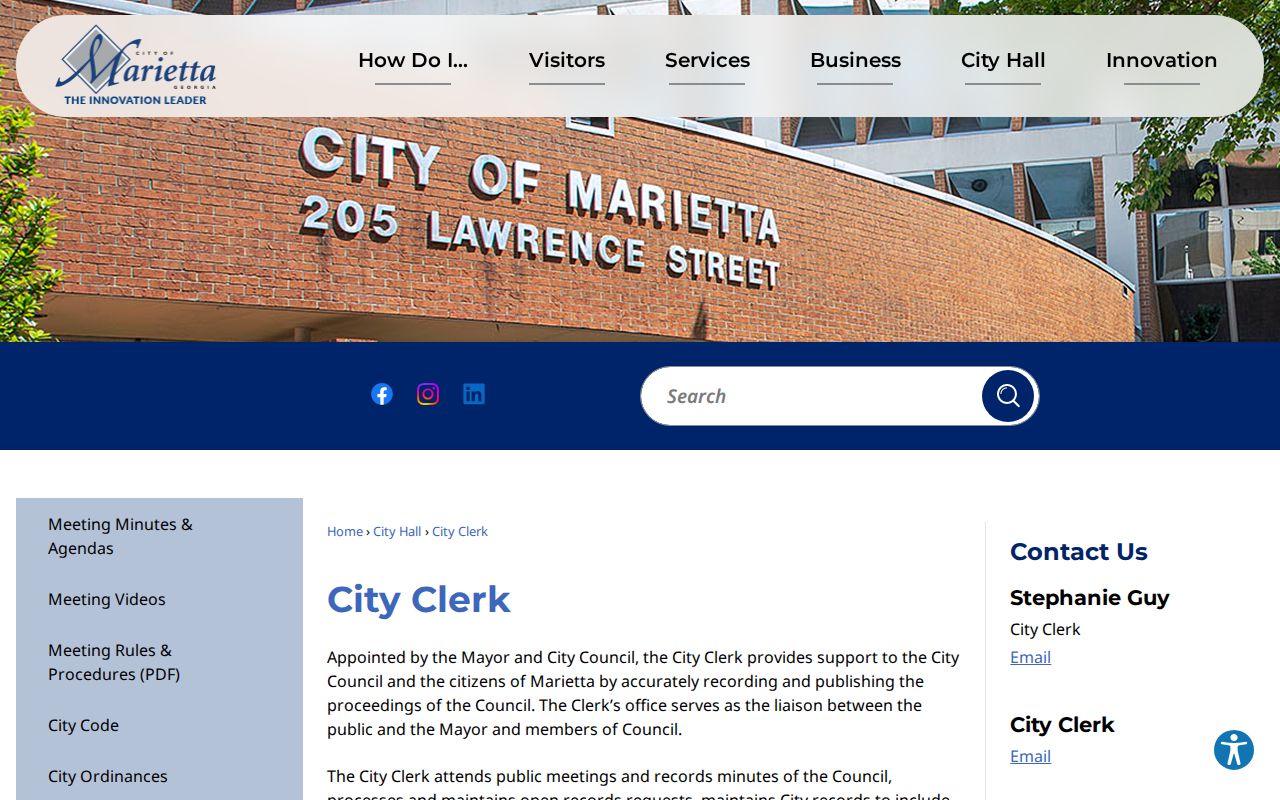
That official city source helps prevent a request from being sent to the wrong government.
Read Cobb Property Results
The assessor is useful because it joins a name, parcel, and location. It does not list all residents. Cobb tax records distinguish the situs address, where the parcel sits, from the mailing address used for the bill. The named owner is anchored to January 1 for the tax year. Homestead status can support a primary-residence inference for a qualification date, but it is not a household roster.
| Property field | What it means | Main caution |
|---|---|---|
| Owner | Assessed owner for the tax year | May be an entity or nonresident |
| Situs | Physical parcel address | Not the tax-mailing destination |
| Parcel ID | Key joining assessor, tax, and GIS | Copy every character |
| Tax district | Municipal or county tax jurisdiction | Postal city may differ |
| Homestead | Exemption status | Does not identify other occupants |
- Parcel
- A mapped unit of land with its own identifier.
- Situs address
- The physical location of the property.
- Index
- A search aid pointing to a record, not always the record image itself.
- Criss-cross directory
- A printed directory arranged by street and house number.
Follow Marietta Names Into Deeds
The Cobb Clerk's Landmark system offers name, document, book and page, parcel ID, record-date, instrument-number, legal, and quick searches. The clerk advises testing spelling variants. GSCCCA adds statewide real-estate searches by name, book and page, and property fields such as county, subdivision, unit, block, and lot. Some images and advanced options require an account or payment.
Roles matter. A grantor gives or transfers an interest; a grantee receives it. Start with the assessor's current owner and deed reference, open the acquisition record, then search the grantor as an earlier grantee. Match parcel ID, subdivision, lot, and legal description. Street text alone can break when names or numbers change.
Current Marietta Directory Sources
Modern resident evidence is spread across purpose-built indexes. Each source lists a limited class of people and reflects its own update cycle. The best Marietta residents directory result is therefore a documented match, not a claim that one roll represents the whole city.
| Official source | People or roles shown | Custodian | Access |
|---|---|---|---|
| Property roll | Owners and mailing recipients | Cobb Tax Assessor | Free web search and counter |
| Deed index | Grantors, grantees, and other recorded parties | Cobb Superior Court Clerk | Landmark, GSCCCA, deed room |
| My Voter Page | One voter's registration details | Georgia Secretary of State | Identifying inputs required |
| Court indexes | Public case parties and docket roles | Correct municipal or county court | Coverage and retention vary |
| Business and license indexes | Officers, agents, and credential holders | Georgia Secretary of State | Free verification portals |
A business address, registered-agent address, or court contact address is not automatically a home. A Marietta resident lookup should verify one person across independent sources.
Search Cobb Court Names
Court jurisdiction is split. Marietta Municipal Court handles city misdemeanor traffic and ordinance matters. Cobb State Court publishes civil cases from March 17, 1997 and traffic or misdemeanor cases from April 26, 1999. Superior, Magistrate, and Probate courts keep other case types. Georgia's E-Access page is a directory to participating systems, not one complete statewide party index.
The Cobb State Court portal supports party, case, filing-date, case-type, and status searches, including phonetic name matching. Results can include case number, parties and roles, filing or disposition data, assigned judge, and docket entries. Its data refreshes nightly and retrieval is capped at 5,000 rows. A court address may reflect filing-time data or a later update, so keep the case number and dates with any address.
The Cobb State Court search entry displays the access notice before the case query.
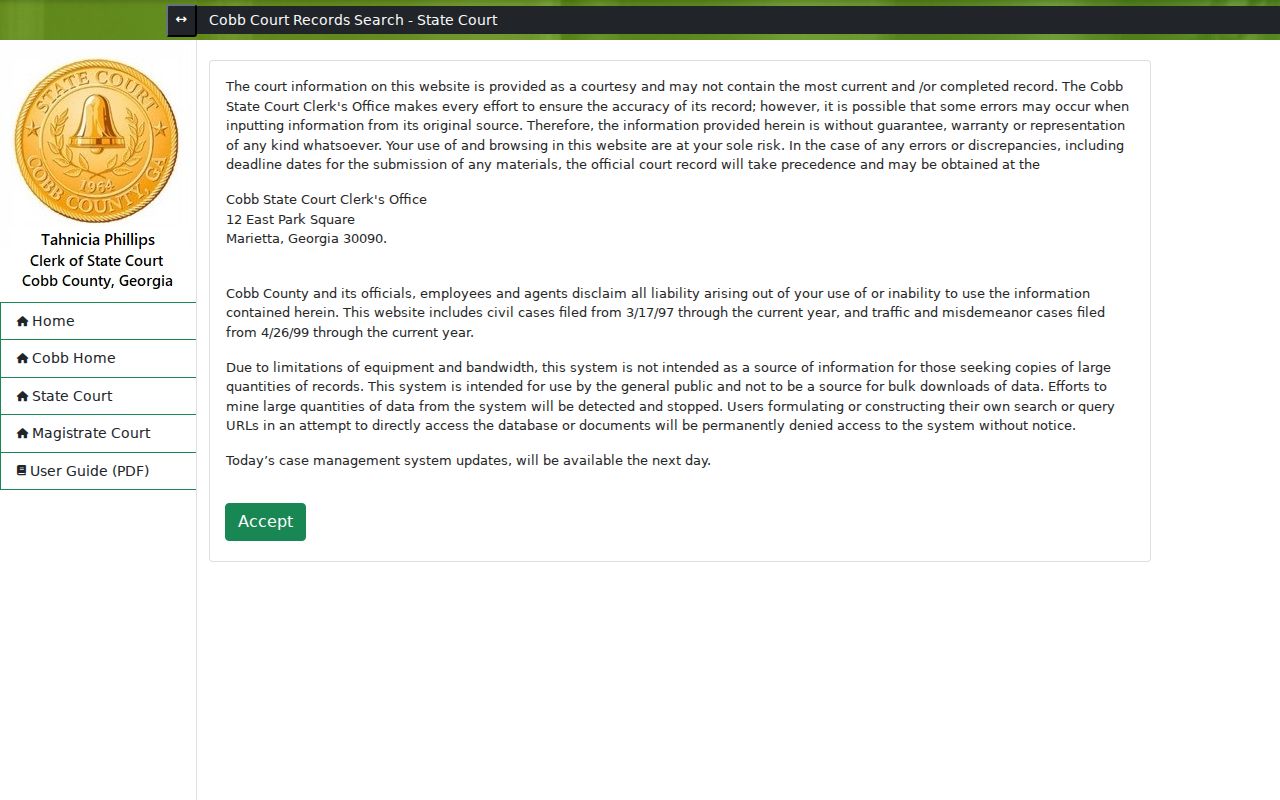
The disclaimer and coverage notes are part of the result's context, not a screen to skip without reading.
Use Georgia Voter Records
Georgia My Voter Page is an individual verification tool. It uses a first initial, last name, county, and date of birth, then returns registration status, registered residence, precinct, polling place, districts, early-voting details, and sample-ballot information. It never reveals ballot choices, and Georgia does not register voters by party.
Public voter lists are a separate paid process. State law governs their fields and use. The file may include structured residence and mailing addresses, precincts, districts, dates, birth year, race, gender, and a prior primary ballot type. It excludes a full birth date, Social Security number, driver's-license number, and phone. VoteSafe shields qualifying voters' residence information. A missing or inactive record is not proof that someone moved.
The Georgia My Voter Page provides the official self-lookup.
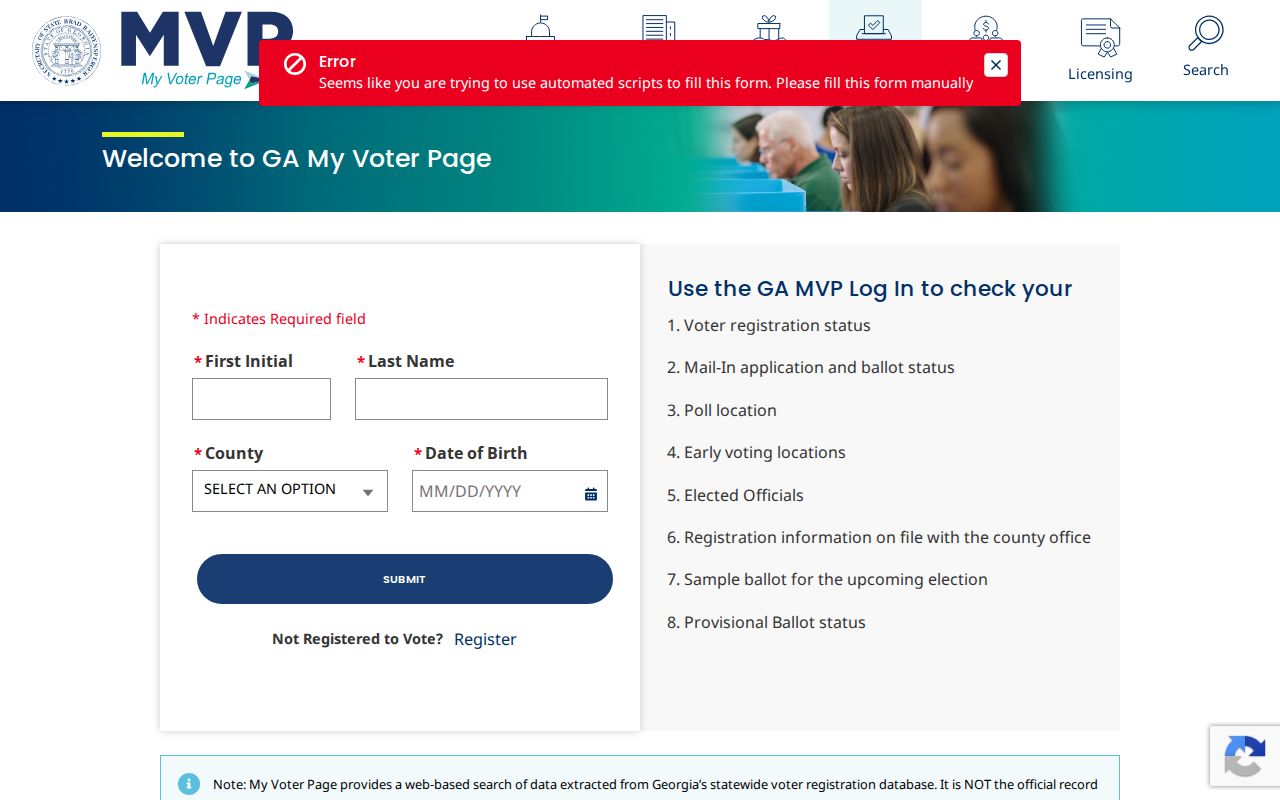
The input screen confirms why the service cannot be browsed as a street-by-street resident roll.
Order Marietta Vital Records
Vital certificates answer event questions, not broad directory searches. Cobb and Douglas Public Health provides local birth and death copies. Cobb Probate Court keeps marriage applications and licenses, while divorce decrees belong with Superior Court. The Georgia Department of Public Health serves statewide birth, death, marriage, and divorce-report requests.
Certified birth records are limited to eligible applicants. Death-record access also depends on eligibility, with cause-of-death information more restricted. Historical access varies by series and transfer status. An obituary, cemetery entry, or probate filing can be a public lead, but none replaces a certified record when legal proof of an event is required.
The Georgia Vital Records office publishes the current order routes and eligibility guidance.

The state page helps identify the right certificate and prevents an ineligible or misrouted request.
Request Missing Marietta Records
The Georgia Open Records Act, O.C.G.A. §§ 50-18-70 through 50-18-77, lets any person request existing public records. Written delivery to the designated officer is safest. An agency should produce available records as soon as practical and within three business days. If production takes longer, the agency should give a description, timetable, cost estimate, and the exact statutory basis for withheld material.
Ask for a real record series and a narrow date range. Agencies need not create a report that does not exist. Request native electronic format when useful, set a cost ceiling, and ask for an estimate. The first fifteen minutes of search, retrieval, and redaction labor are free; later labor uses the lowest-paid qualified worker. Ordinary copies may cost up to 25 cents per page under the general rule, though specific fee schedules can differ.
Compare Official and Compiled Results
Official indexes have defined custodians, fields, dates, and correction paths. Commercial people-finder products blend public records with marketing data and other sources. They can merge same-name residents, retain old addresses, and assign relatives or prior occupants to the wrong household. A polished result is not the same as a sourced one.
Official record
Shows a specific legal or administrative fact, such as assessed ownership, a filed case, or a credential status. Coverage limits are usually stated.
Compiled profile
May be quick to search, but source dates and matching logic can be unclear. Treat it only as a lead and return to the custodian.
Correct an error at its source. Suppressing a compiled profile does not change a deed, docket, tax roll, or voter record.
Browse Marietta Historical Directories
The Georgia Room's verified local shelf begins with a Marietta and Acworth volume for 1883–84, then resumes with Marietta City in 1936 and mixed-community runs through 1987. Those endpoints describe collection holdings, not the first or last directory ever printed. A directory may list an adult, spouse, occupation, employer, home address, and owner or renter notation for one publication year.
Charles D. Switzer Library's Georgia Room, the Marietta History Center, the Digital Library of Georgia, Georgia Archives, federal census records, and cemetery sources fill different gaps. The 1956 Nelsons' directory includes alphabetical and householders sections and says it sought residents age sixteen and older. Scan images matter because OCR can lose abbreviations, spouse notation, ownership marks, and minor-child counts.
Cobb's 1864 courthouse fire creates real gaps, but it did not erase every record series. Deeds, tax and court remnants, newspapers, churches, cemeteries, census schedules, and later directories must be combined carefully. The full shelf, year runs, and abbreviation key appear in the Marietta city directories reference.
Trace Marietta Community Memory
Marietta's local collections extend beyond printed names. The History Center launched an expanding online collections database in 2025 and also offers research appointments for photographs, scrapbooks, videos, and reference files. Kennesaw State University holds regional oral-history collections, including Marietta's anniversary and Cobb civil-rights interviews. Oral recollection should be checked against records made at the time.
Historic districts add another address layer. Atlanta-Frasier, Church-Cherokee, Northwest Marietta, Washington Avenue, and Whitlock Avenue are National Register districts. City design-review packets can name owners, applicants, designers, and properties. Marietta GIS also exposes aerial layers labeled 1961, 1974, 1983, and 1988. Those images can date physical change, but they do not name the people who lived there.
Even small local records can matter. The City Clerk keeps cemetery deeds, yet a burial-lot purchaser is not always the person interred. Pair that deed with cemetery, obituary, probate, and death evidence. This measured approach makes a historical residents directory useful without turning an inference into a fact.