
Marietta City Directory Years Held
The Charles D. Switzer Library’s Georgia Room keeps the verified local spine. Coverage begins with combined Marietta and Acworth volumes, then resumes with Marietta-only books before expanding to Smyrna and other Cobb communities. These are holdings dates, not proof that the first or last directory ever printed falls at either end.
| Local directory group | Years represented | Where kept | How to use it |
|---|---|---|---|
| Marietta and Acworth | 1883, 1884 | Switzer Library Georgia Room | Consult the local-history collection |
| Marietta City | 1936; 1938–39; 1941; 1944; 1947; 1950; 1952; 1956 | Georgia Room; 1956 at DLG | In person or free digital scan for 1956 |
| Marietta and Smyrna | 1958–60; 1962; 1964–70 | Georgia Room | Consult by available year |
| Marietta-Smyrna example | 1975 | Digital Library of Georgia | Free searchable scan |
| Four-community Cobb run | 1977; 1985–86; 1987 | Georgia Room | Marietta, Smyrna, Acworth, and Kennesaw in one title |
The official holdings list supplies years but does not name every publisher. Two imprints are verified: Nelsons’ City Directory Co. for 1956 and Mullin-Kille for 1975. Calling the whole shelf a Polk series would invent a fact. Gaps are equally important. A missing year may reflect the surviving collection, the publication schedule, or another unknown cause, so a blank interval should be bridged with other records.
Research Marietta Directories at Switzer
The Georgia Room is more than a directory shelf. It holds over 15,000 reference resources and provides microform, genealogy databases, immigration material, heraldry and pedigree works, Garrett’s Necrology, Kennesaw State oral histories, and cemetery volumes. A reader can move from a Marietta city directory entry to a census household, obituary lead, or local archival collection without treating the listing as the last word.
One-hour help from a genealogy librarian may be reserved through the desk at 770-528-2333. The separate archival finding aids search 11 collections by operator, type, field, and year. In-person help matters when OCR misses a name, the directory year is not digitized, or a street label has changed.
The Georgia Room’s cemetery sources add a careful fallback. Its Cobb cemetery volume covers Marietta City Cemetery, which began in the 1830s. Cemetery evidence may explain why a person disappears from later books, but a marker, deed, or transcription should be checked against an interment or death record.
Search Marietta City Directories Online
Georgia Public Library Service reported that 214 directories from 17 communities were digitized with the Digital Library of Georgia and 12 library systems. Marietta, Austell, Mableton, Acworth, and Smyrna are among the communities. Full-text searching is free. The 1956 Marietta scan and the 1975 Marietta-Smyrna scan are direct local examples.
Search text helps locate a candidate page, but the scan image controls. Old type, narrow columns, abbreviations, and faint ownership marks can confuse OCR. Inspect the page before and after a match, capture the title and year, and save the front-matter key with the entry. A surname search alone may also miss a wife listed only in parentheses or a person found through the street guide.
Note: Use the catalog record and scanned page together, since OCR is a finding aid rather than a transcription.
Decode a Marietta City Directory Entry
The 1956 front matter states that residents age 16 and older were listed. Wives appear in parentheses, a number after the wife can show children under 16, and a symbol marks home ownership. A compact line may also carry initials, an occupation, an employer, a street address, and a phone or business reference.
| Name and initials | The indexed person, with a spouse sometimes in parentheses |
|---|---|
| Family marks | A spouse name, a minor-child count, or “wid” followed by the late spouse |
| Work detail | An abbreviated occupation and sometimes the employer |
| Address code | “h” for home, “r” for residence or rooms, “apt” for apartment, and “same” for the business address just given |
| Ownership mark | A publisher symbol that may disappear from OCR |
One inspected line names John A. Bishop, his spouse Johnnie M., his police patrolman work, and a West Dixie Avenue home. Another marks Viola C. Chalker as the widow of J. H. These examples show how one short listing can join kin, work, and place. They also show why the key must be read before expanding an abbreviation.
- Criss-cross directory
- A directory arranged by street and house number, useful when the address is known first.
- Householder index
- The street-order section that places listed names beneath addresses.
- Abbreviation key
- The publisher’s legend for short forms and symbols; copy it before interpreting entries.
Use Both Marietta Directory Guides
The alphabetical section and the Householders Guide solve different problems. Begin with the name section when a surname is known. It can expose a spouse, work detail, and address. Then turn to the street guide to inspect the same house number and nearby listings in that publication year. If the address is known but the family name is not, reverse that order.
The 1956 volume also includes classified businesses, a numerical telephone section, and rural routes. A business line or phone reference is an affiliation, not proof of a home address. Likewise, a householder listing names those included by the publisher’s rule, not every person who slept at the property.
For modern parcel and deed work by address, use the Marietta street directory. The historical city directories remain the better tool for a listed household in a publication year.
Marietta Directory Milestones and Gaps
The local record timeline explains why one search method cannot cover every era. It also separates verified collection milestones from broader claims about publication history.
| Date | Verified Marietta directory milestone |
|---|---|
| 1883–84 | Combined Marietta and Acworth volumes appear in Georgia Room holdings |
| 1936 | The next verified Marietta City volume after the early pair |
| 1956 | Nelsons’ Marietta City Directory, now digitized by DLG |
| 1958–70 | Available years use combined Marietta and Smyrna titles |
| 1975 | Mullin-Kille Marietta-Smyrna digital example |
| 1977–87 | Selected holdings combine Marietta, Smyrna, Acworth, and Kennesaw |
| 2023 | State library service announces the multi-community digitization project |
These dates describe available holdings. They do not prove that 1883 was the first publication or that 1987 was the last printed directory. The courthouse record loss tied to 1864 and the later directory gaps also caution against claiming that an absent name means an absent resident.
For the long break after the 1884 holding, search deeds, tax and court remnants, cemetery records, newspapers, churches, and federal sources. Cobb’s courthouse burned during the 1864 campaign, but the surviving research does not identify every series lost. It would be wrong to say all county records vanished. The safer method names the exact surviving source and leaves undocumented years unresolved.
Marietta History Center Adds Context
The Marietta History Center research collection holds photographs, research files, community scrapbooks, videos, reference books, maps, and school yearbooks. Research is by appointment. These sources can explain a directory reference that the printed volume compresses, especially a school, civic group, business, neighborhood, or streetscape.
Review the History Center’s research holdings before viewing the page capture.
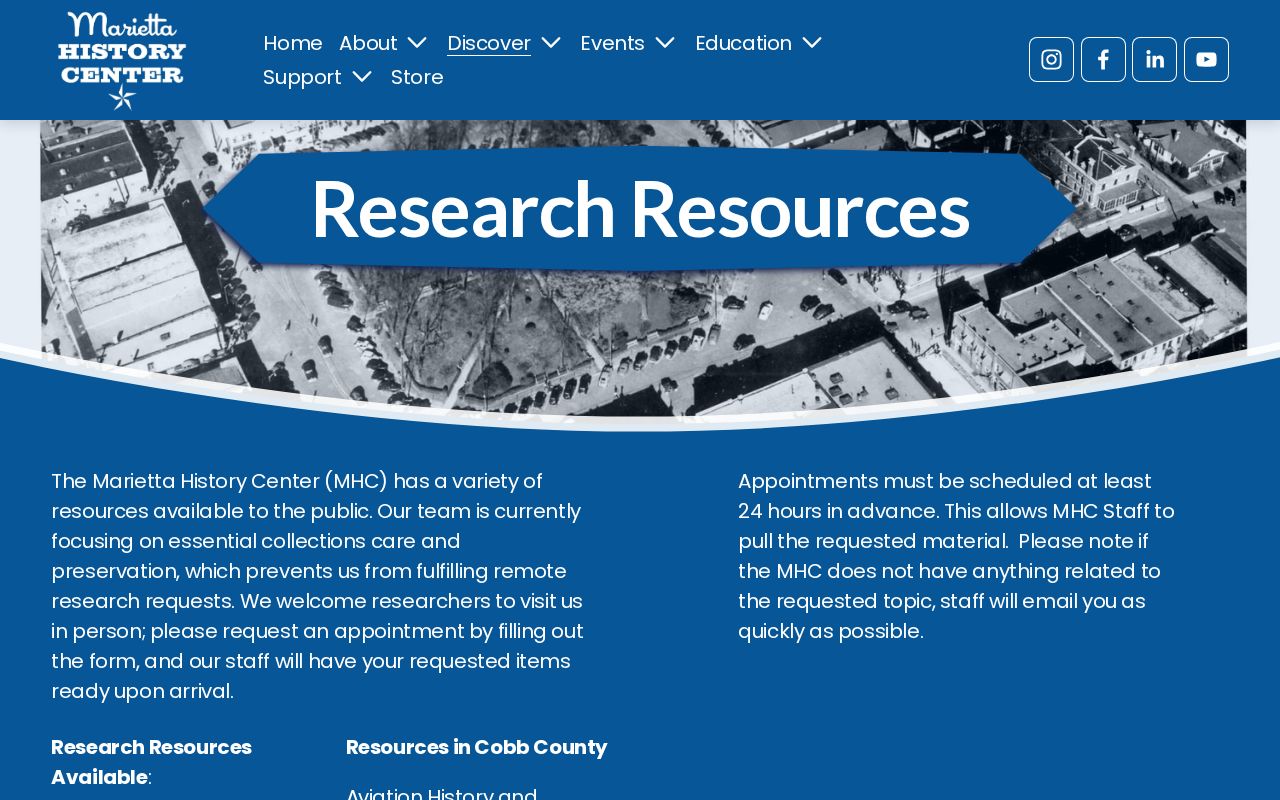
The capture points to the appointment-based archival layer that complements the Georgia Room and DLG scans.
In 2025, the History Center also launched an expanding online collections database with thousands of artifacts, photographs, and archival materials. It broadens remote discovery, but additions remain ongoing. A keyword result should be tied back to its catalog record and original item.
Local oral history adds still another voice. Kennesaw State’s regional collection includes City of Marietta anniversary and Cobb County series. The Cobb NAACP/Civil Rights series contains 41 interviews, with transcripts deposited at KSU Archives and the Georgia Room. Recollection is valuable context and should be paired with records made near the event.
Trace Family Through Marietta Directories
Build a dated chain, not a story from one entry. The sequence below uses each Marietta city directory as a checkpoint and gives gaps to a source with a different inclusion rule.
- Find the first available entry by surname and save the page, year, title, and abbreviation key.
- Record spouse, child count if shown, work detail, ownership symbol, and the printed address without expanding uncertain text.
- Check the Householders Guide for the same address, then move to the next available directory year.
- Search a spouse independently after a widow notation or when the first-listed person disappears.
- Pair the 1940 and 1950 public census with nearby directory years, using the census enumeration date as its own checkpoint.
- Use deeds for title, probate or obituaries for a death or estate trail, and cemetery records for burial evidence.
A disappearance can mean death, a move, a missed publication, a change in who was listed, or an OCR failure. It does not prove which one. Spouse names, occupations, exact addresses, and dates help distinguish same-name people. Two independent records are stronger than a repeated claim copied from one directory.
Marietta’s history makes broad searching important. The city grew around rail, industry, military production, historic Black institutions, and changing neighborhood boundaries. School, church, cemetery, newspaper, preservation, and oral-history collections may recover people missed by a nominally citywide volume. Absence from one directory can reflect how the publisher gathered names, not absence from Marietta.