
Find Marietta Residents Carefully
Match the record to the question first. The Cobb assessor links an owner to a parcel and tax-mailing address. A deed names the parties to a recorded transfer. A voter result confirms one registration. A city directory places a listed household at an address for a single publication year. Related facts, but not interchangeable. A registered agent can work somewhere without living there. Owners rent houses out all the time.
Start from the strongest detail you hold, whether a full name, street address, parcel ID, case number, or directory year. Note the date of each search, since Marietta GIS refreshes its property data nightly and Cobb State Court updates on the same cycle. Tax ownership is anchored instead to the tax year, so a result lacking an "as of" date is easy to misread.
- Confirm whether the address is inside Marietta rather than merely using a Marietta postal label.
- Search the Cobb property roll by owner or address and copy the parcel ID, situs address, and mailing address.
- Follow deed references through the Cobb Clerk or GSCCCA index, checking party roles and legal descriptions.
- Compare a second independent source, such as a court docket, voter self-lookup, license file, or dated directory.
- Send a narrow Georgia Open Records Act request to the proper custodian when the existing file is not online.
Marietta Resident Record Keepers
Marietta is the Cobb County seat, so several major custodians sit near the Square. Custody still decides where any record lives. City minutes and cemetery deeds stay with the City Clerk, while the Superior Court Clerk holds recorded land instruments. The Tax Assessor produces parcel appraisals, and elections officials keep the voter rolls. Ask for a named index, file, or record series. An office will not identify a person for you.
Both offices open on weekdays. Check the office page before traveling, though, because hours and access procedures change.
Verify the Marietta City Line
A Marietta mailing address proves nothing about the city line. Utility service does not either, as the city itself warns about Marietta Power and Water. Use the shaded city-limit map instead. A city tax bill also settles it. A Marietta City Schools assignment works too. The city property tool autocompletes an address. It reports the parcel and school assignments. It also notes that its GIS data updates nightly.
This check steers where the search goes next. A permit for an unincorporated Cobb parcel belongs to the county. A city permit, by contrast, runs through Marietta. An "Unincorporated Cobb" tax district is strong evidence the postal label misleads. The Marietta street directory works out the full address chain.
Put the test into practice. The official Marietta property tool applies the city-limit check on a live parcel query.
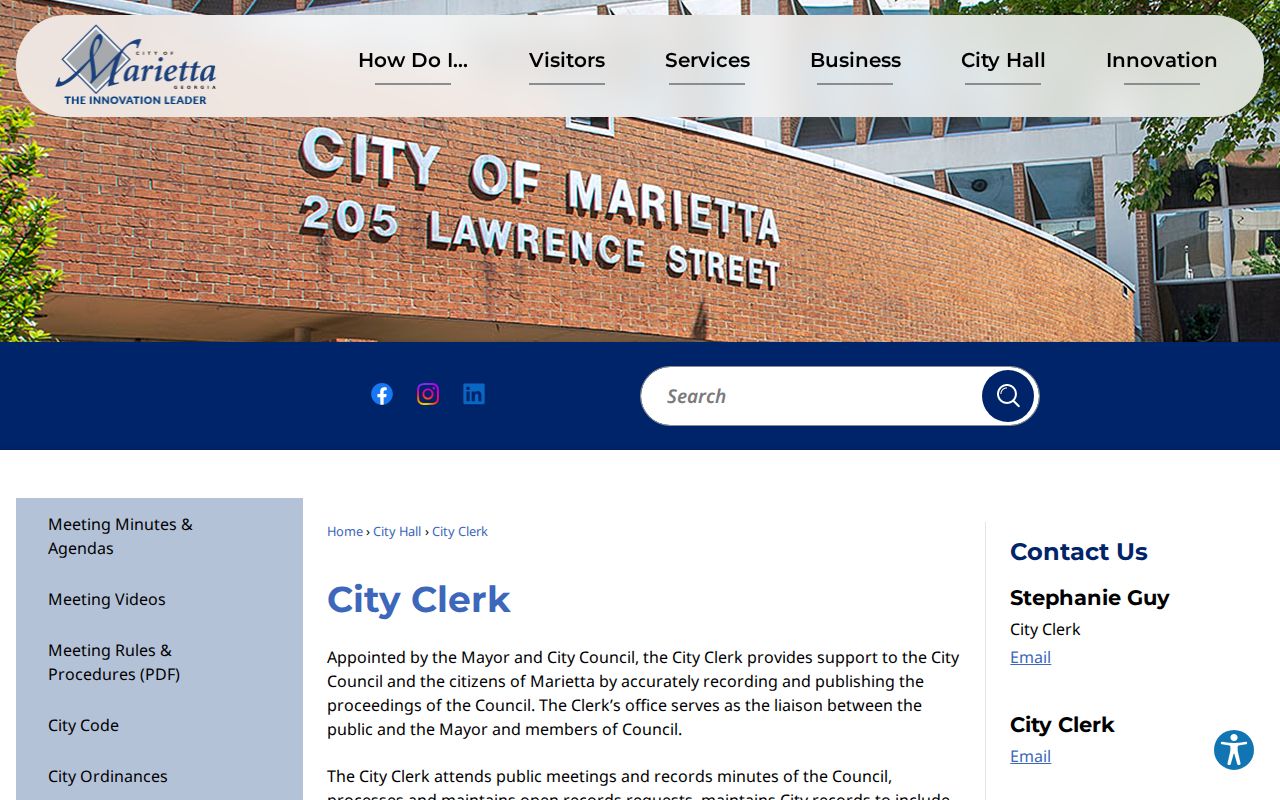
That official city source keeps a resident lookup from landing on the wrong government.
Read Cobb Property Results
The assessor earns its keep by joining a name, a parcel, and a location. It is not a roster of residents. Homestead status can support a primary-residence inference. That inference holds only for the January 1 date of the tax year. Cobb tax records also separate the situs, where the parcel sits, from the mailing address the bill uses. Neither field gives you a household.
| Property field | What it means | Main caution |
|---|---|---|
| Owner | Assessed owner for the tax year | May be an entity or nonresident |
| Situs | Physical parcel address | Not the tax-mailing destination |
| Parcel ID | Key joining assessor, tax, and GIS | Copy every character |
| Tax district | Municipal or county tax jurisdiction | Postal city may differ |
| Homestead | Exemption status | Does not identify other occupants |
- Parcel
- A mapped unit of land with its own identifier.
- Situs address
- The physical location of the property.
- Index
- A search aid pointing to a record, not always the record image itself.
- Criss-cross directory
- A printed directory arranged by street and house number.
Follow Marietta Names Into Deeds
The Cobb Clerk's Landmark system searches by name, document, book and page. It also handles parcel ID, record date, instrument number, legal description, and a quick mode. The clerk recommends testing spelling variants. GSCCCA widens the net statewide. It runs real-estate searches by name, book and page, and property fields like county, subdivision, unit, block, and lot. Some images and advanced options need an account or payment.
Roles matter in a deed. A grantor transfers an interest, and a grantee receives it. Begin with the assessor's current owner and deed reference. Open the acquisition record. Then search that grantor as an earlier grantee. Match on parcel ID, subdivision, lot, and legal description. Street text alone breaks when names or numbers change.
Current Marietta Directory Sources
Modern resident evidence is scattered across purpose-built indexes. Each lists a narrow class of people. The best Marietta residents directory result is a documented match across sources, never a claim that one roll covers the whole city.
| Official source | People or roles shown | Custodian | Access |
|---|---|---|---|
| Property roll | Owners and mailing recipients | Cobb Tax Assessor | Free web search and counter |
| Deed index | Grantors, grantees, and other recorded parties | Cobb Superior Court Clerk | Landmark, GSCCCA, deed room |
| My Voter Page | One voter's registration details | Georgia Secretary of State | Identifying inputs required |
| Court indexes | Public case parties and docket roles | Correct municipal or county court | Coverage and retention vary |
| Business and license indexes | Officers, agents, and credential holders | Georgia Secretary of State | Free verification portals |
Not every address is a home. A business, registered-agent, or court contact address may not be where someone lives, so a Marietta resident lookup should verify one person across independent sources.
Search Cobb Court Names
Court coverage in Marietta is divided among several benches. Marietta Municipal Court takes city misdemeanor, traffic, and ordinance matters. Cobb State Court opens its civil cases back to March 17, 1997. Its traffic and misdemeanor dockets reach back to April 26, 1999. Superior, Magistrate, and Probate courts hold the remaining case types. So a name that misses in one court may sit in another. Georgia's E-Access page is a directory to participating systems, not one complete statewide party index.
The Cobb State Court portal searches by party, case number, filing date, case type, and status. Phonetic name matching is built in. Results can return case numbers, parties and their roles, filing or disposition data, the assigned judge, and docket entries. Data refreshes nightly. Retrieval is capped at 5,000 rows. A court address on a case may reflect filing-time data or a later update. So carry the case number and dates alongside any address you save.
The Cobb State Court search entry displays the access notice before the case query.
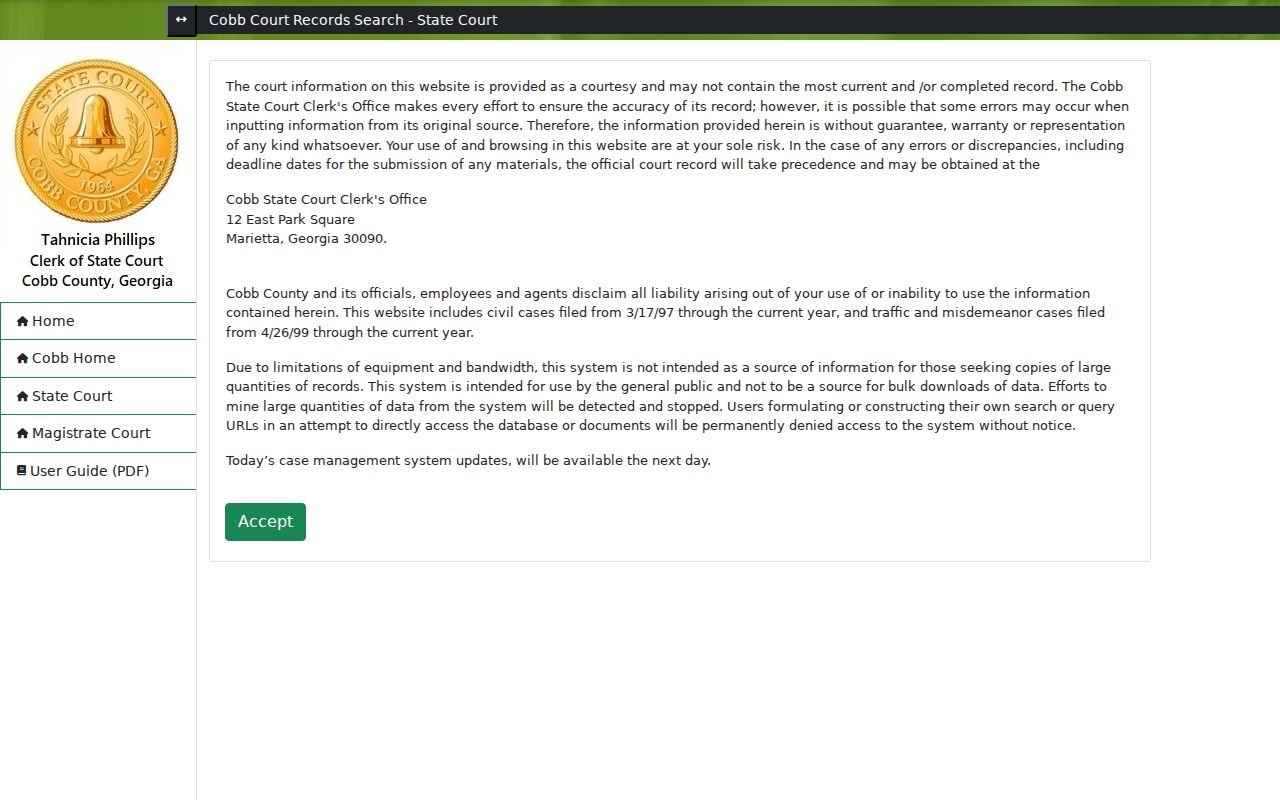
The notice and coverage notes frame the results, so they earn a read rather than a quick skip.
Use Georgia Voter Records
Georgia My Voter Page verifies one voter at a time. It asks for a first initial, last name, county, and date of birth. In return it shows registration status and registered residence. It also lists precinct, polling place, districts, early-voting details, and sample-ballot information. It never reveals ballot choices. Georgia does not register voters by party. The page holds no party label.
Public voter lists are a different, paid process governed by state law. Fields may include structured residence and mailing addresses, precincts, districts, and dates. They may also hold birth year, race, gender, and a prior primary ballot type. A full birth date, Social Security number, driver's-license number, and phone stay out. VoteSafe shields residence information for qualifying voters. A missing or inactive record is not proof that someone moved.
The Georgia My Voter Page provides the official self-lookup.
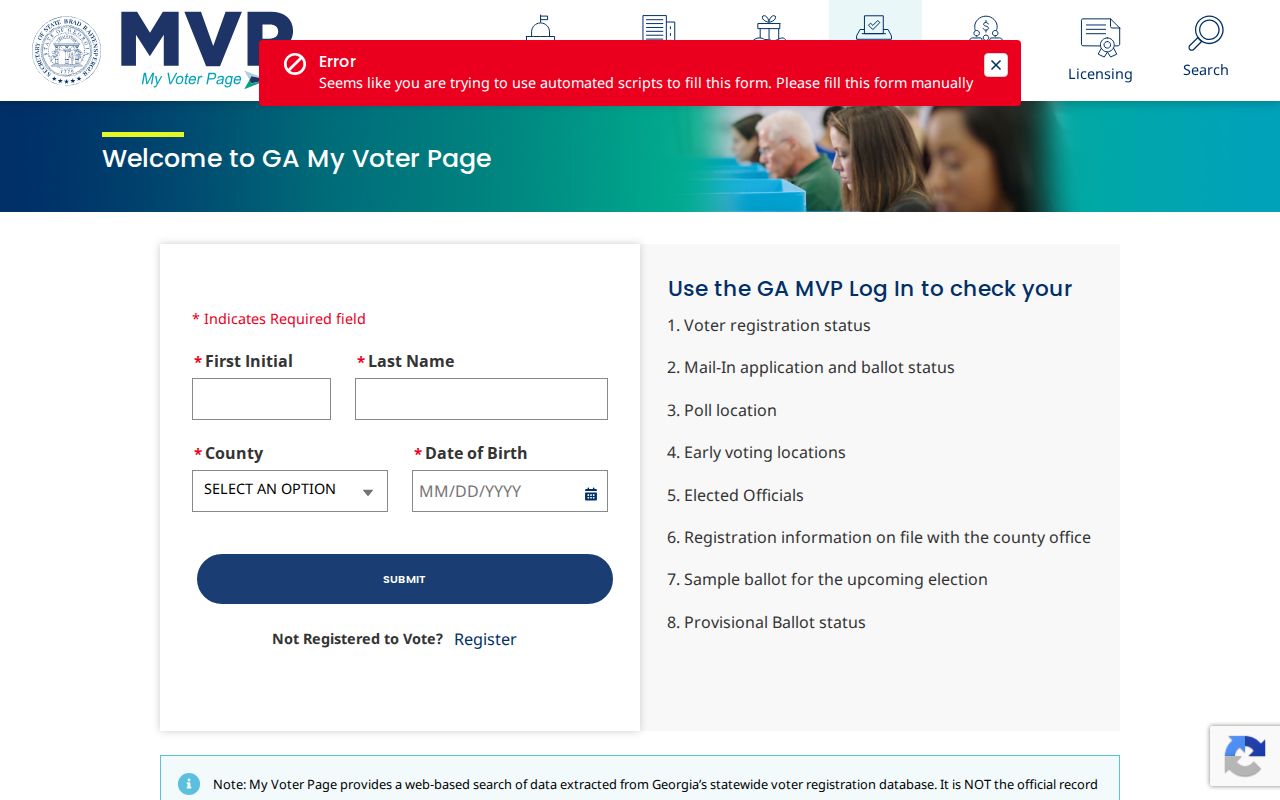
The input screen itself shows why this tool cannot serve as a street-by-street resident roll for Marietta.
Order Marietta Vital Records
Vital certificates prove one event, not a directory search. Cobb and Douglas Public Health issues local birth and death copies for the Marietta area. Marriage licenses come from Cobb Probate Court. Divorce decrees belong to Superior Court. Statewide birth, death, marriage, and divorce-report requests route through the Georgia Department of Public Health.
Eligibility rules guard certified birth and death records alike. Cause-of-death details face the tightest limits. Historical access varies by series and transfer status, and while obituaries, cemetery entries, and probate filings offer public leads, none replaces a certified record when legal proof of an event is required. The Georgia Vital Records office publishes the current order routes and eligibility guidance.

The state page helps you order the right certificate and avoid a misrouted request.
Request Missing Marietta Records
Georgia's Open Records Act, O.C.G.A. §§ 50-18-70 through 50-18-77, lets any person request existing public records. Put the request in writing. Deliver it to the designated records officer. An agency should produce available records as soon as practical and within three business days. If production takes longer, the agency must give a description, timetable, cost estimate, and the exact statutory basis for anything withheld.
Name a real record series. Keep the date range narrow. Agencies need not create a report that does not exist, so request native electronic format when useful, set a cost ceiling, and ask for an estimate. The first fifteen minutes of search, retrieval, and redaction labor are free, and later work bills at the lowest-paid qualified worker's rate. Ordinary copies generally cost up to 25 cents per page. Specific fee schedules can differ.
Compare Official and Compiled Results
An official index has a custodian, defined fields, set dates, and a correction path. Commercial people-finders work differently. They blend public records with marketing data, merge same-name residents, retain old addresses, and assign relatives or prior occupants to the wrong household. A polished result is not a sourced one.
Official record
An official record states a specific fact the government itself maintains. That might be assessed ownership on the parcel rolls, a filed case on the docket, or a credential status. Coverage limits are usually stated plainly.
Compiled profile
A compiled result can feel fast. But its matching logic and source dates stay hidden, so treat any hit as a lead. The custodian's own records settle the question.
Fix mistakes where they live. Hiding a compiled profile changes nothing at the deed, docket, tax roll, or voter record level. Only the custodian of that record can correct it.
Browse Marietta Historical Directories
The Georgia Room's verified shelf starts with a combined Marietta and Acworth volume covering 1883–84. The run resumes with Marietta City in 1936 and mixed-community issues through 1987. Those dates describe what the collection holds, not the first or last directory ever printed. A single volume may name an adult, a spouse, an occupation, an employer, and a home address. It may also note whether the household owned or rented. That detail covers one publication year only. Switzer Library's Georgia Room, the Marietta History Center, the Digital Library of Georgia, and Georgia Archives each fill different gaps. Federal census records and cemetery sources fill others. The 1956 Nelsons' directory carried alphabetical and householder sections. It aimed at residents sixteen and older. Scan the images. OCR often drops abbreviations, spouse notations, ownership marks, and minor-child counts. Cobb's 1864 courthouse fire left real gaps. It did not wipe out every series. Deeds, tax and court remnants, newspapers, churches, and cemeteries still have to be pieced together. So do census schedules and later directories. The full shelf and year runs sit in the Marietta city directories reference. So does an abbreviation key.
Trace Marietta Community Memory
Marietta's paper trails are only the start. The History Center opened a growing online collections database in 2025. Its research appointments open doors to photographs, scrapbooks, videos, and reference files. Kennesaw State University adds regional oral-history holdings. Among them are Marietta anniversary interviews and Cobb civil-rights recordings. Oral recollection should be checked against records made at the time.
Historic districts add another address layer. Atlanta-Frasier, Church-Cherokee, Northwest Marietta, Washington Avenue, and Whitlock Avenue all sit on the National Register. Design-review packets filed with the city can name owners, applicants, designers, and the properties involved. The Marietta GIS viewer also serves aerial layers labeled 1961, 1974, 1983, and 1988. Those images help date physical change, though they never name the people who lived there.
Small records can matter too. The City Clerk holds cemetery deeds. Yet the purchaser of a burial lot is not always the person interred. Pair that deed with cemetery, obituary, probate, and death evidence. That measured approach keeps a historical residents directory honest without turning an inference into fact.